The Rio platform

One gateway per building. Every reading, trusted and kept.

Rio works with the protocols already on site, runs control, graphics and alarms on the box itself, and sends every reading to Oversee in the cloud.

From plant room to twin, once a minute

  1. 1 · On site

    Site systems

    The BMS, plus systems outside it such as lighting control.

    BACnet · Modbus · KNX · OPC UA

  2. 2 · Gateway

    Rio

    Reads every point once a minute and holds data through outages.

    Outbound MQTT over TLS

  3. 3 · Cloud

    Oversee

    Archives every reading first, then summarises each hour and day.

    Parquet · API · CSV

  4. 4 · Yours

    Your twin

    Twin platform, BI or data lake, reading only the sites you grant.

    Read-only, open formats

Rio Gateway

Fit one box, and the building is yours to read, control and reach.

DIN rail, one power feed, one network port. Registered with a one-time code, with applications switched on from the cloud and no site visit.

  • Field side
  • 4 × RS485 isolated, 120 Ω termination
  • 1 × CAN isolated, to 1 Mbit/s
  • 2 in · 2 out isolated digital I/O
  • Gigabit Ethernet field network
7–36 V DC screw terminal, supply included
  • Upstream
  • 2.5 Gigabit Ethernet building network, outbound only
  • Rio Control and Oversee outbound internet is enough
Processor
Quad-core 64-bit Arm Cortex-A76, 2.4 GHz
Memory and storage
4 GB LPDDR4X · 32 GB eMMC · M.2 NVMe expansion
Enclosure
Finned aluminium, fanless · 136 × 92 × 39.5 mm
Mounting
DIN rail clip and VESA plate, both supplied
Identity
Certificate issued at registration, revoked on decommission
Clock
Real-time clock, battery-backed

On the gateway

One box, several jobs.

Each application is a module on the gateway, licensed per device and switched on from Rio Control. Logic, alarms and graphics run on the box itself, so when the line is down the building carries on.

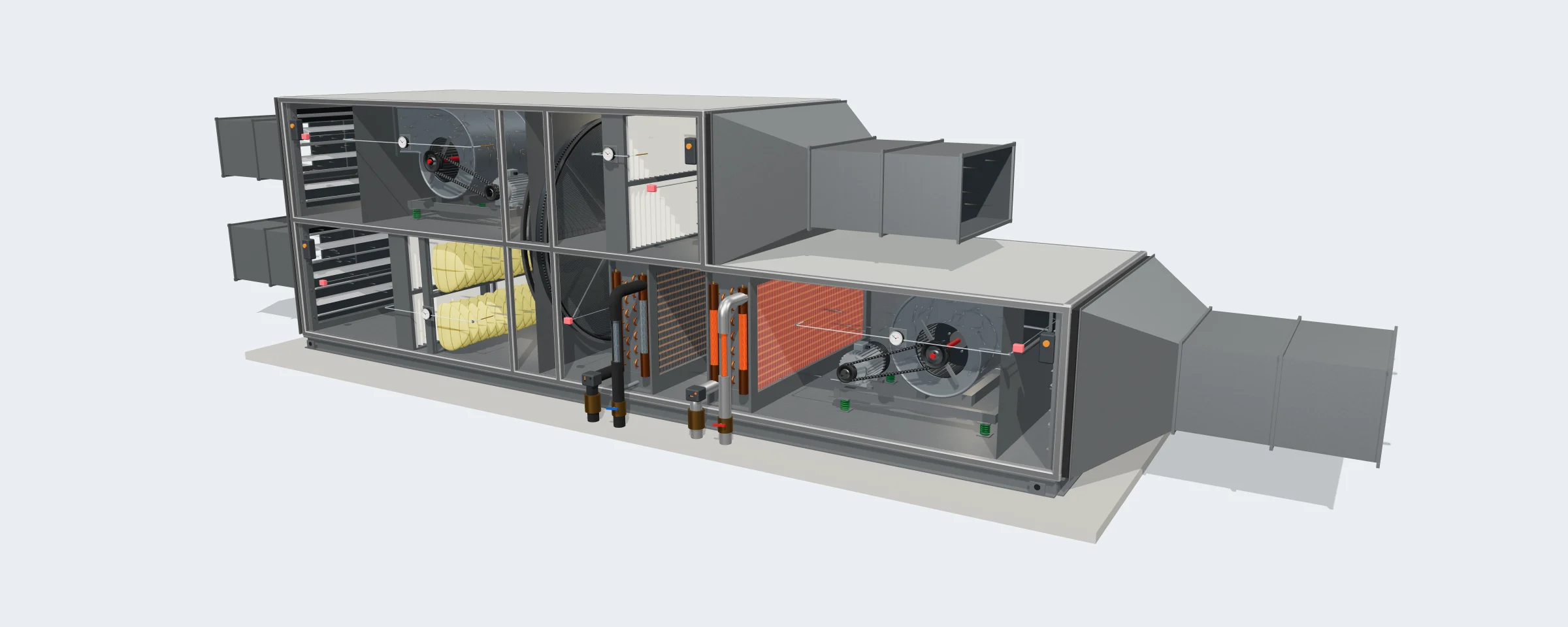
A double-deck air handling unit drawn in 3D by Rio Graphics

Graphics

Live site graphics, with plant drawn in 3D.

Engineers design pages of widgets bound to live site data; operators use them in the Rio interface or full screen on wall panels. Plant is drawn in 3D and follows the real thing: fans turn, the heat wheel rotates and water flows while its valve is open.

  • A plant designer that builds your plant section by section
  • Buttons, toggles, sliders and schedules that write back to the plant
  • Full-screen kiosk pages for wall panels
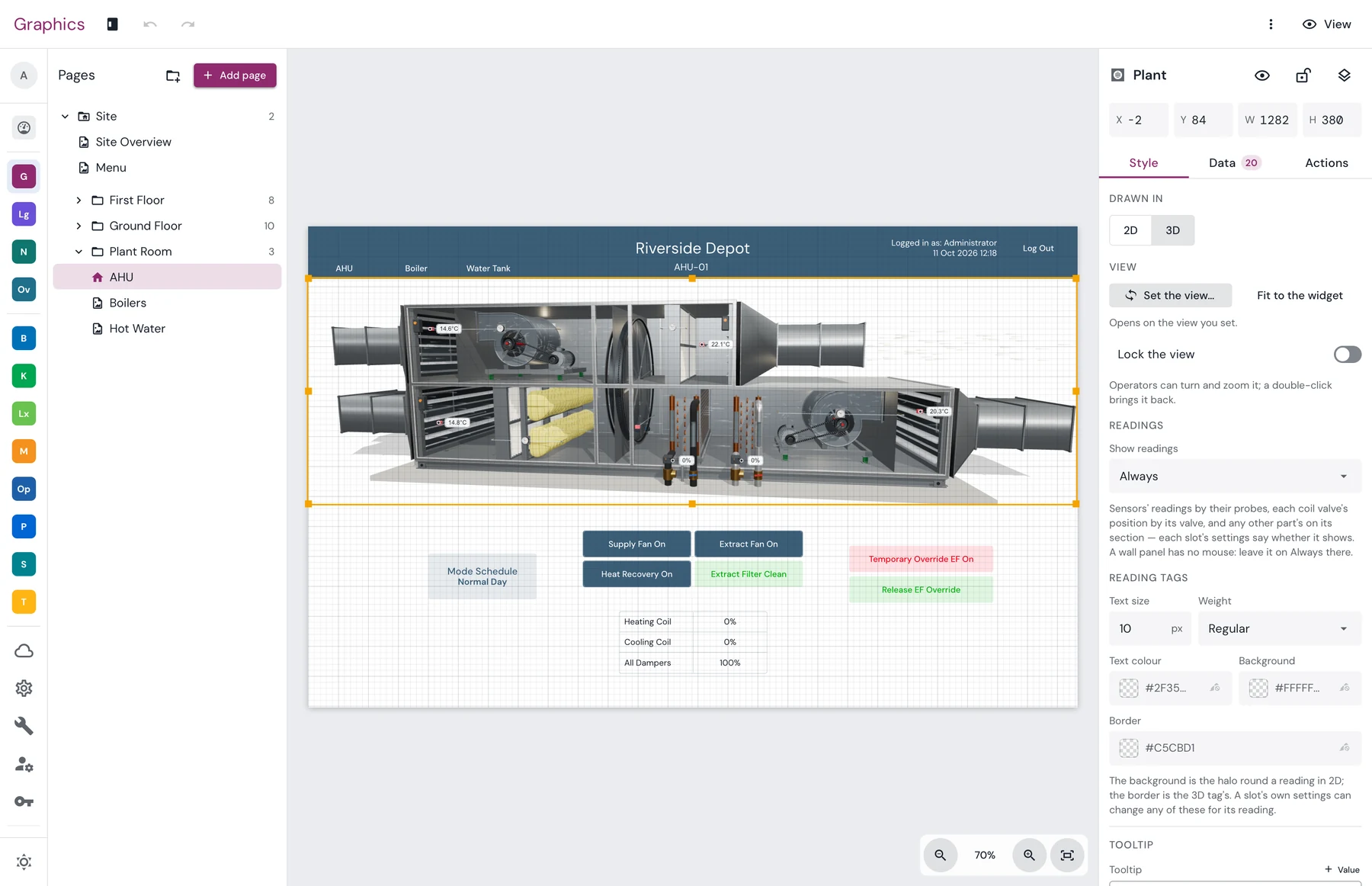
The Rio Graphics editor with an air handling unit page open: the site's pages and folders on the left, the 3D AHU selected on the page with its readings tagged, and its settings on the right, including 2D or 3D, the opening view, when readings show and how their tags look
The Graphics editor: some demo plant
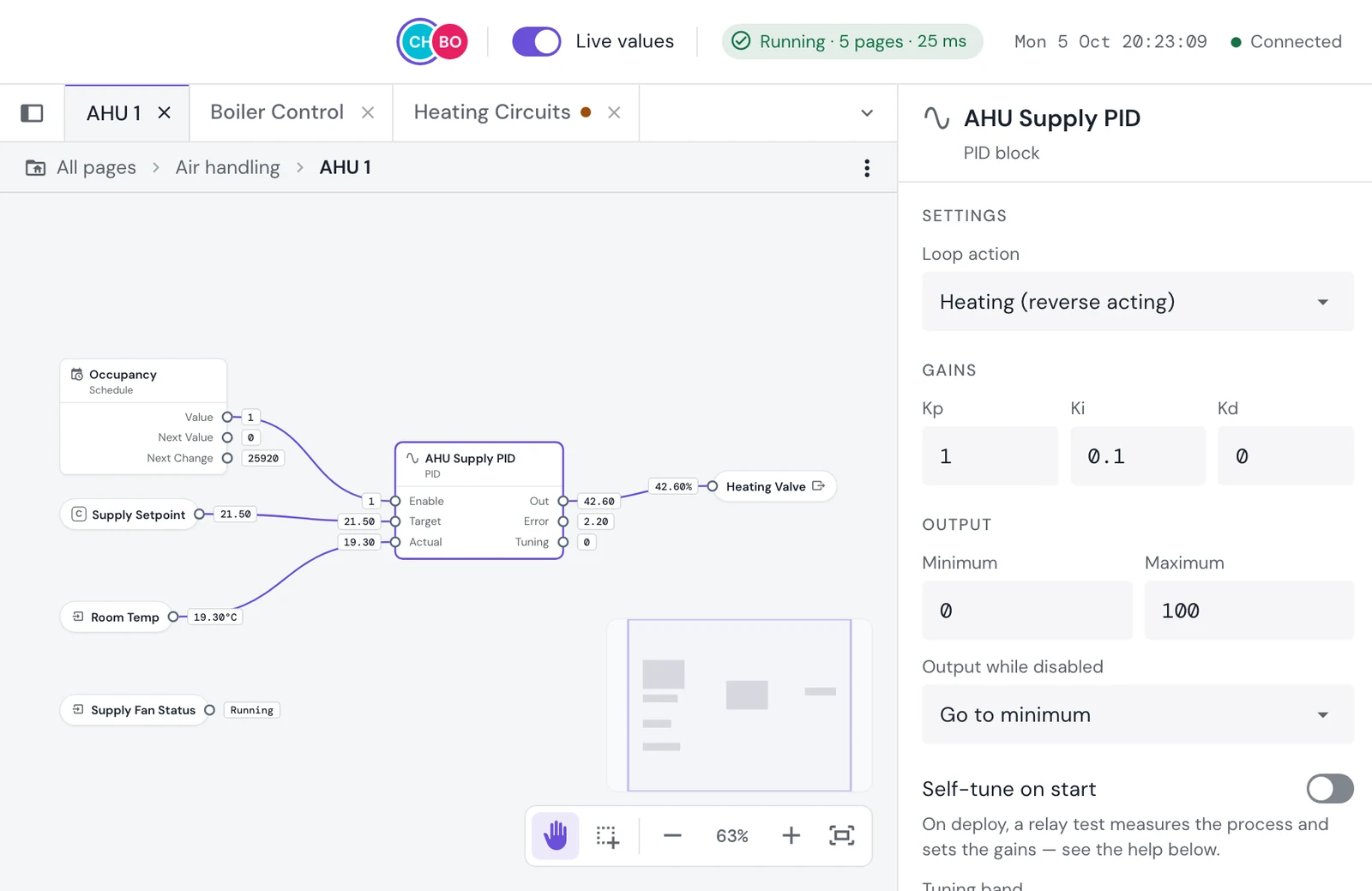
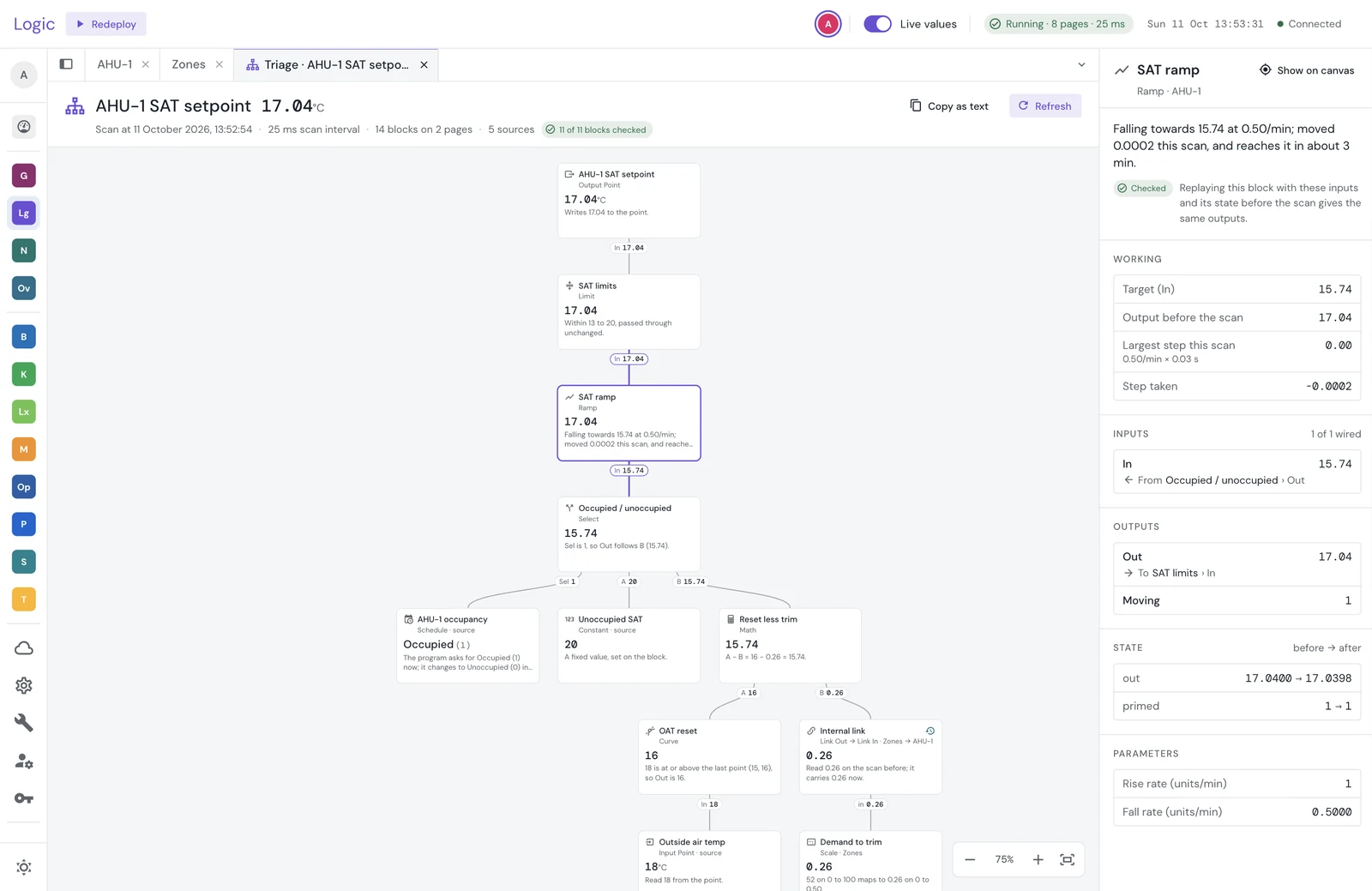
The Rio Logic editor: a PID block wired to an occupancy schedule, a supply setpoint and a room temperature, driving a heating valve, with the block's settings open Triage mode in Rio Logic: an air handling unit's supply air setpoint traced back through its limit, ramp and occupied or unoccupied select to the schedule, outside air reset and zone demand behind it, with the ramp's working on the right
Rio Logic · a supply air PID loop with live values on its wires Rio Logic · triage mode, tracing a setpoint back to its inputs

Logic

Control logic, built and deployed.

A block editor for building control. Build a program from inputs, gates, timers, PID loops and schedules, then deploy it to the gateway. Everyone connected edits one shared draft and can see each other's changes as they happen, allowing for collaborative logic design and review. Every change is recorded and you can go back in time if new logic ever causes a problem.

  • PID loops that can tune themselves on deploy
  • Schedules, curves and expressions with editors of their own
  • Live values on every connection, visible while the program runs
  • Triage mode that traces any output back to its inputs, with no wiresheets to trawl

Alarms

Triggers by point and class, contact groups and webhooks.

Network monitor

Watch what is on your network, monitor performance, and alert on unknown devices.

Remote access

Site systems from anywhere, with a killswitch, locked to only the users and networks you specify.

Oversee connector

Ships a reading a minute to the cloud archive, and holds readings through an outage.

Oversee

The data layer your digital twin is waiting for.

Oversee records what a building is actually doing, every temperature, meter, pump, valve, fan and fault, once a minute, and keeps it for the life of the building. It is a monitoring platform, not a control system: it watches a building, and cannot operate one.

Minute detail for 90 days by default, or longer by agreement; hourly and daily summaries kept for good.

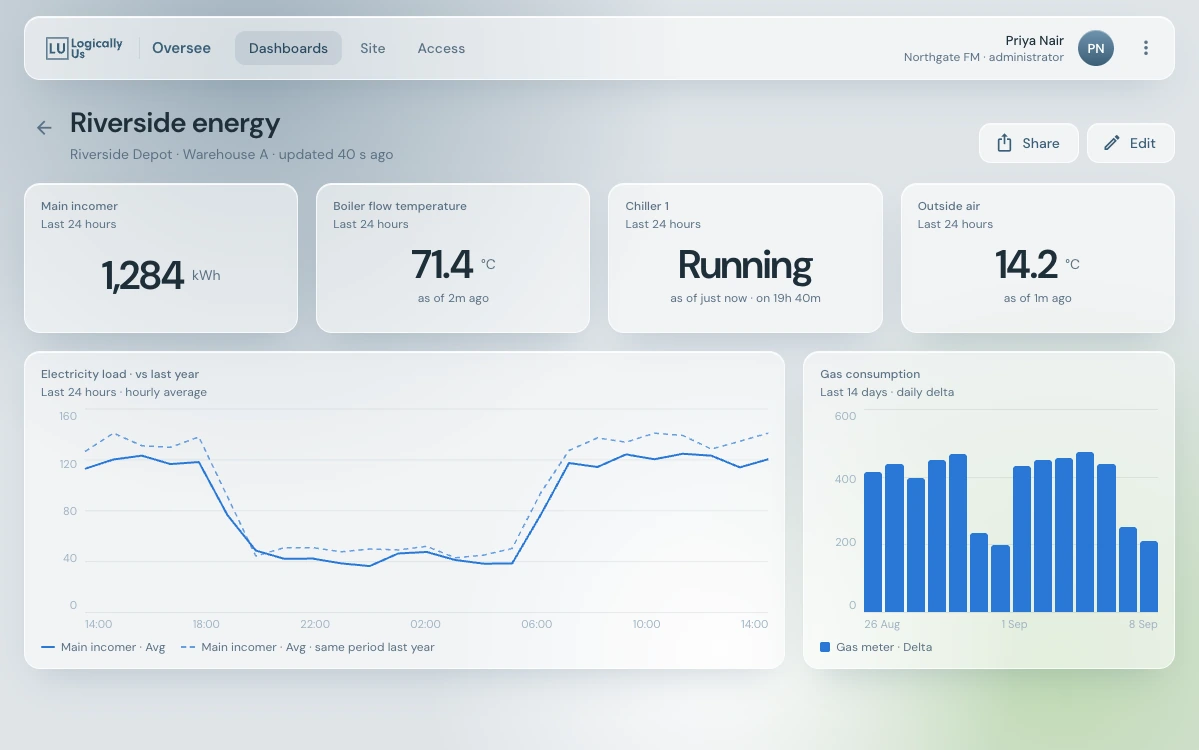
An Oversee dashboard showing main incomer energy, boiler flow temperature, chiller state and outside air temperature, with electricity load against the same period last year and daily gas use

Nothing is lost

Every reading is archived before anything is done with it, gateways keep recording through an outage and catch up afterwards, and every summary can be rebuilt from the original readings.

Every figure carries its trust

When a sensor fails or a meter goes quiet, the chart says so, with the reason. A gap is never filled with a guess, and a missing hour is never drawn as a zero.

Totals that match the meter

Totals are taken from the meter's own register, so they always agree with the meter itself. Glitches are caught, and wraps, resets and meter replacements are handled, never guessed.

Three ways to get it out

Archive access

Full history as Parquet, by site and day, for Athena, Spark, Databricks or any Parquet reader.

Query API

Machine-to-machine access for your twin platform, scoped to the sites you grant.

Export and import

Minute data as CSV on request. Commissioning logs and meter records imported into the same history.

Integrations

Works with the protocols already on site.

Client and server on BACnet and Modbus, so data flows both ways between Rio and the building's own systems.

BACnet/IP client and server
BACnet MS/TP over isolated RS485
Modbus TCP client and server
Modbus RTU over isolated RS485
KNX lighting and room control
OPC UA industrial and plant systems
MQTT devices and brokers
SNMP network and IT equipment
LoRaWAN via a Milesight gateway
EcoStruxure EWS Schneider Electric web services
And many more

Rio and your BMS

Run the building on Rio, or keep your existing BMS.

Rio can control a building itself, with its own logic, graphics and alarms running on the gateway. If you don't want to use our logic, you can keep your existing BMS: Rio sits alongside Trend, Niagara or EcoStruxure, collecting data for the twin. This is how Rio compares with a typical BMS supervisor.

Aspect A BMS supervisor, typically Rio with Oversee
Built to Run plant on one site: setpoints, sequences and alarms Run plant on site, or work beside the BMS, and keep trusted data across a whole estate
Sources Its own controllers first; other systems via drivers Its own field interfaces, the BMS where there is one, and systems outside it such as lighting, water or ventilation control
History Trend logs set up point by point, sized for fault-finding Every point, every minute; hourly and daily summaries kept for good
Data quality A failed sensor and a flat line can look the same Bad readings and outages marked with the reason, kept out of totals
Portfolio A head-end per site, or an extra enterprise layer Every building in one organisation, behind one sign-in
Network Remote access by VPN or an inbound port Outbound MQTT over TLS to AWS IoT Core. Nothing to open
Data out Exports and integrations per vendor, per site Open Parquet archive, query API and CSV, the same on every site
Risk Changes are made on the live control system Control stays on site, on the gateway or the BMS. Oversee only observes; remote operation is limited to people you authorise

Comparisons describe a typical BMS deployment, not any one product.

Secure by design

Built to pass the client's IT review, not to work around it.

Nothing inbound

The gateway connects out to AWS IoT Core over MQTT and TLS. No inbound rule, static address or VPN.

Its own identity

Each Rio is issued a certificate when registered, revoked the moment it is decommissioned.

Observation, not control

Oversee can tune how a site reports, never how it runs. Remote operation, where enabled, goes through Rio's own interface and permissions.

Organisations kept apart

No organisation can list, see or claim another's devices or data.

Least-privilege sharing

A client, FM provider or twin team sees only what you share, and you can revoke it centrally.

Single sign-on

One sign-in across the platform, with multi-factor authentication and passkeys.

What the client's IT team will ask

Which ports need opening?
None inbound.
Where is the data held?
AWS, in the EU (Ireland).1
Who can see it?
Only who you grant.
Can the cloud change the building?
Only if you allow it.2

1 By default.

2 Oversee only observes. Where Rio runs the logic and remote access is enabled, people you authorise can operate the building through the gateway's own interface, under strict permissions you control.

From a hospital estate to a single home.

Smaller sites

Sites without a full BMS

Where a site doesn't warrant a full BMS, Rio can provide comprehensive control and visualisation, as well as collecting the data.

  • Control logic
  • Graphics and wall panels
  • Alarms and notifications

Residential

Homes and residential schemes

Rio suits residential installations too, bringing lighting, shading, audio and home automation into one place with the same graphics, logic and remote access.

  • Loxone
  • Philips Hue
  • Somfy TaHoma
  • Sonos

Try us on a project.

See what the Rio platform can do for your building, campus or whole estate.

Ask for a demonstration

office@logicallyus.com · 01183 111 010